When planning refrigeration for a supermarket, grocery store, or other commercial food retail business, you may come across two common types of refrigeration equipment: plug-in and remote refrigerated cabinets.
But what exactly is a remote refrigerated display cabinet, and how does it work?
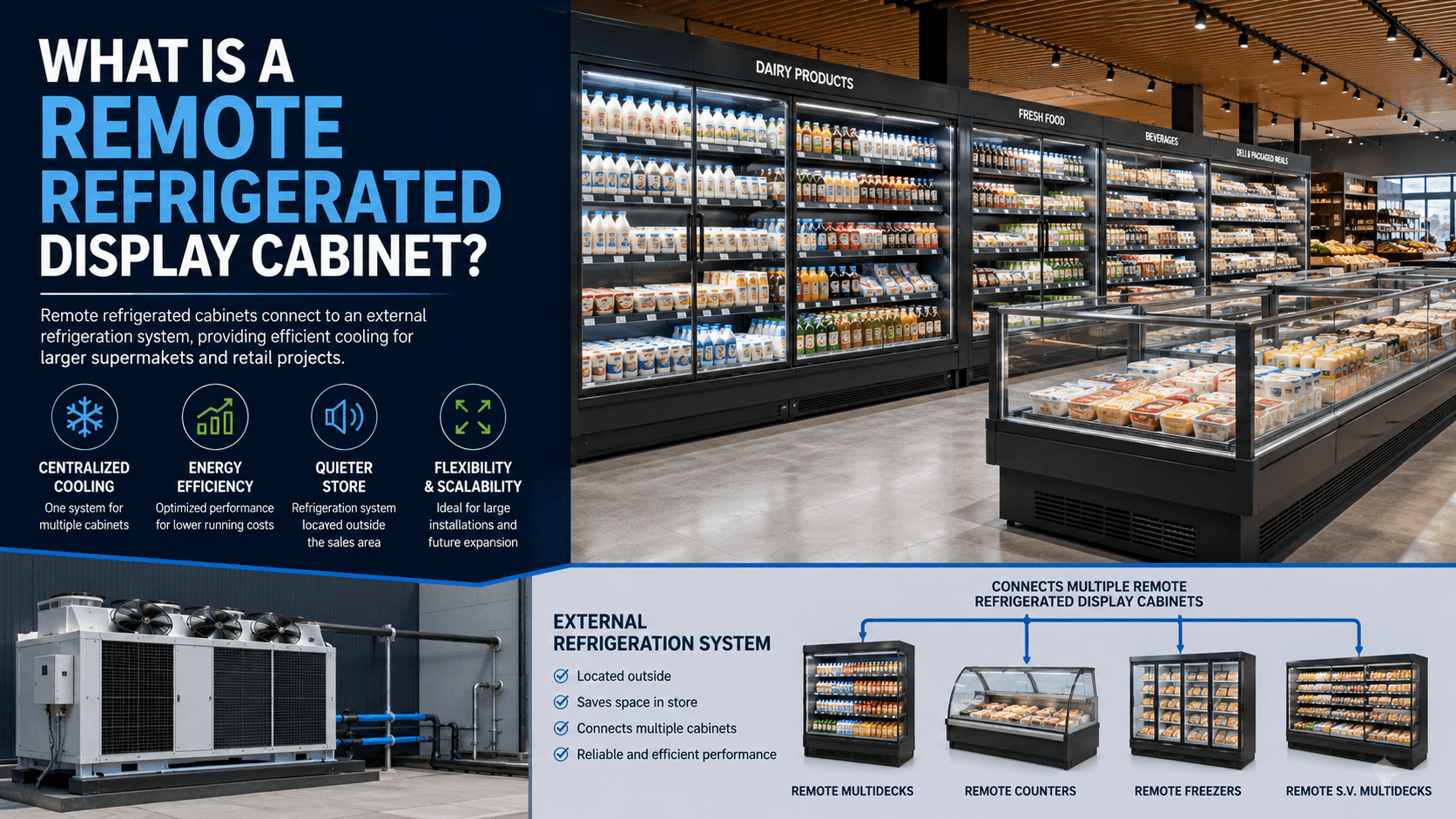
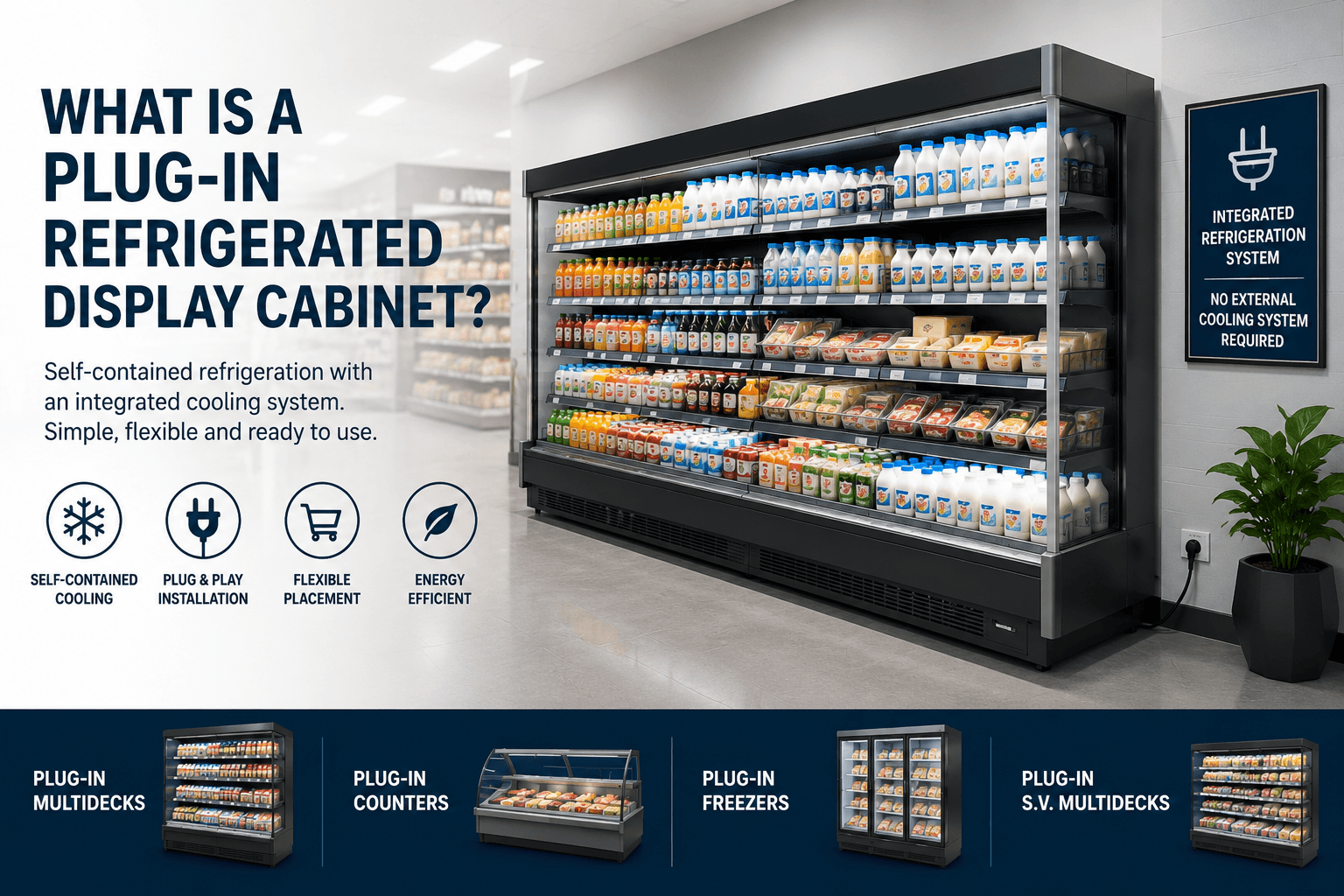
Unlike a plug-in cabinet, which has its own integrated refrigeration system, a remote refrigerated cabinet is connected to an external refrigeration system. This configuration can be particularly useful for larger supermarkets and commercial refrigeration projects where several refrigerated cabinets need to operate as part of a centralized system.
In this guide, we explain how remote refrigerated cabinets work, their main benefits, the different types available, and what you should consider before choosing one for your business.
Table of Contents
What Is a Remote Refrigerated Display Cabinet?
A remote refrigerated display cabinet is a commercial refrigeration cabinet that does not contain its own complete refrigeration unit.
Instead, the cabinet is connected to a separate refrigeration system, often located outside the sales area or in a designated technical space.
The remote system provides the cooling required to maintain the appropriate temperature inside the display cabinet.
This setup is commonly considered for:
- Supermarkets
- Hypermarkets
- Large grocery stores
- Food retail stores
- Commercial food outlets
- Large-scale refrigeration projects
Because the refrigeration system is separated from the display cabinet, remote refrigeration can provide greater flexibility when designing larger retail refrigeration installations.
How Does Remote Refrigeration Work?
A remote refrigeration system works by connecting refrigerated display cabinets to an external refrigeration system.
The basic process is:
- The refrigeration system generates the cooling required by the cabinets.
- Refrigerant circulates through the connected refrigeration circuit.
- The evaporator inside the display cabinet absorbs heat from the cabinet area.
- The refrigeration system removes that heat from the store environment.
- The cabinet maintains the required temperature for the products being displayed.
Unlike a self-contained plug-in cabinet, the main refrigeration components are not integrated into the individual display cabinet.
This allows multiple cabinets to be connected to a centralized refrigeration infrastructure, depending on the design of the project.
Remote vs. Plug-In Refrigeration
The main difference between remote and plug-in refrigeration is where the refrigeration system is located.
Remote Refrigerated Cabinets
With a remote system:
- The refrigeration system is external to the cabinet.
- Multiple cabinets can potentially be connected to a central system.
- The refrigeration infrastructure is planned as part of the overall project.
- It can be suitable for larger supermarkets and retail installations.
Plug-In Refrigerated Cabinets
With a plug-in system:
- The refrigeration unit is integrated into the cabinet.
- Each cabinet operates as a self-contained refrigeration unit.
- Installation can be simpler for certain applications.
- It can be suitable for smaller stores and individual refrigeration requirements.
Neither system is automatically better than the other. The right choice depends on the size of the store, number of cabinets, available infrastructure, installation requirements, and overall project design.
What Are the Advantages of Remote Refrigerated Cabinets?
Remote refrigeration can offer several advantages for larger commercial applications.
1. Suitable for Larger Supermarkets
One of the main reasons businesses consider remote refrigeration is scalability.
A large supermarket may require many refrigerated display cabinets across different sections of the store. Connecting multiple cabinets to a planned refrigeration system can be more practical than installing a separate refrigeration unit inside every cabinet.
2. Better Integration With Store Design
Because the main refrigeration equipment is located separately from the display cabinet, the sales area can have a cleaner and more consistent appearance.
This can be particularly useful when designing large supermarkets where aesthetics, customer movement, and efficient use of floor space are important.
3. Centralized Refrigeration
Remote refrigeration allows several refrigeration units to be integrated into a broader refrigeration system.
This can make it easier to design the refrigeration infrastructure around the needs of the entire store rather than treating every display cabinet as a completely separate system.
4. Reduced Heat and Noise in the Sales Area
In a plug-in cabinet, the integrated refrigeration system operates directly within or around the display unit.
With remote refrigeration, the main refrigeration components can be located away from the customer area.
Depending on the system design, this can help reduce heat and mechanical noise around the supermarket’s sales floor.
5. Flexible Cabinet Selection
Remote refrigeration can be used with different types of commercial display cabinets.
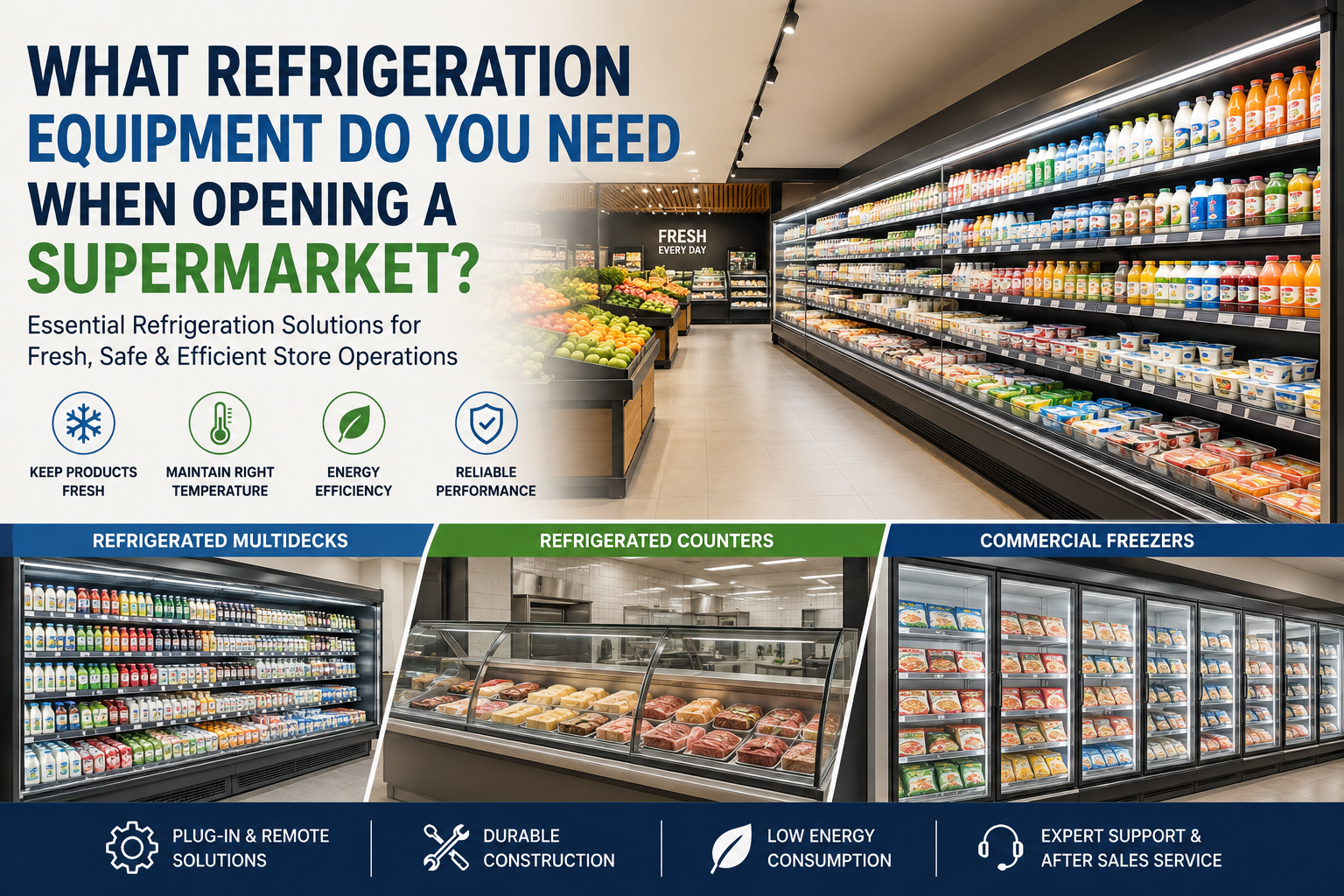
Depending on the project, this can include remote multidecks, counters, freezers, and S.V. multidecks.
What Types of Remote Refrigerated Cabinets Are Available?
Remote refrigeration is not limited to one type of cabinet.
The right cabinet depends on the products you need to display and the layout of your store.
Remote Refrigerated Multidecks
Remote multidecks are designed for displaying chilled products across multiple vertical shelves.
They can be suitable for products such as:
- Dairy products
- Chilled beverages
- Packaged foods
- Fresh foods
- Ready-to-eat products
For larger supermarkets, remote refrigerated multidecks can provide substantial display capacity while connecting to a centralized refrigeration system.
You can explore remote refrigerated multidecks from İnanç Teknik.
Remote Refrigerated Counters
Remote refrigerated counters can be useful where refrigerated storage, display, or working space is required.
They may be suitable for specific supermarket departments and food retail applications where a counter-style configuration works better with the store layout.
You can explore remote refrigerated counters for commercial applications.
Remote Refrigerated Freezers
Supermarkets that sell frozen products may require dedicated freezer equipment.
Remote freezer systems can be integrated into larger refrigeration projects where frozen products need to be displayed and maintained at suitable temperatures.
You can explore remote refrigerated freezers for frozen-food applications.
Remote S.V. Multidecks
S.V. multidecks provide another configuration for commercial refrigeration projects.
They can be considered when the supermarket layout and product range require a specific multideck design.
You can view remote S.V. multidecks for more information.
When Should You Choose a Remote Refrigerated Cabinet?
Remote refrigeration may be worth considering when you are planning:
- A large supermarket
- A hypermarket
- Multiple refrigerated display cabinets
- A new commercial refrigeration installation
- A centralized refrigeration system
- A store with significant chilled or frozen product requirements
For a small shop with only one or two refrigerated cabinets, a plug-in solution may be more practical depending on the application.
The decision should therefore be based on the complete project rather than the cabinet alone.
Is Remote Refrigeration Better for Large Supermarkets?
Remote refrigeration can be a practical solution for larger supermarkets because multiple cabinets can be designed around a centralized refrigeration system.
However, “better” depends on the specific project.
A large supermarket may have different departments, product temperature requirements, operating schedules, and space constraints. The refrigeration system needs to be designed accordingly.
Before selecting equipment, consider:
- Number of refrigerated cabinets
- Product categories
- Required temperature ranges
- Available technical space
- Store layout
- Installation requirements
- Energy consumption
- Maintenance access
- Future expansion
An experienced refrigeration manufacturer can help determine whether a remote system is appropriate for the project.
What Should You Consider Before Buying a Remote Refrigerated Cabinet?
Choosing a remote cabinet requires more planning than simply selecting a cabinet based on size or appearance.
Product Requirements
Determine what products will be stored or displayed and what temperature conditions they require.
Cabinet Dimensions
Measure the available space and consider how the cabinet will affect customer movement and product visibility.
Refrigeration Capacity
The refrigeration system needs to provide sufficient cooling capacity for the connected cabinets and the operating environment.
Energy Efficiency
Since commercial refrigeration can operate for long periods, energy efficiency should be considered during the planning stage.
Installation
Remote systems require appropriate refrigeration infrastructure, piping, electrical connections, and technical installation.
Maintenance
Make sure the system can be serviced efficiently and that replacement components and technical support are available.
Future Expansion
If you expect your supermarket to grow, consider whether the refrigeration infrastructure can accommodate additional cabinets in the future.
Remote Refrigeration and Energy Efficiency
Energy consumption is an important consideration for any commercial refrigeration project.
A remote refrigeration system should be designed according to the actual requirements of the store.
Factors that can influence energy performance include:
- Refrigeration system efficiency
- Cabinet insulation
- Door and glass design
- Lighting
- Ambient conditions
- Product loading
- Temperature settings
- Defrost strategy
- Refrigeration controls
It is important to evaluate the complete system rather than looking at the energy consumption of an individual cabinet alone.
A properly planned refrigeration system can help businesses manage operating costs while maintaining suitable product conditions.
Why Work With an Experienced Refrigeration Manufacturer?
Remote refrigeration projects require coordination between the display cabinets and the refrigeration infrastructure.
An experienced manufacturer can help you select suitable cabinet types, determine the appropriate configuration, and understand the requirements of the overall project.
İnanç Teknik offers remote refrigeration solutions including remote multidecks, counters, freezers, and S.V. multidecks, giving supermarkets and commercial food retailers several configuration options.
For a new supermarket or large refrigeration project, discussing the requirements with the manufacturer before purchasing equipment can help ensure that the selected cabinets are suitable for the intended application.
Remote Refrigerated Cabinet vs. Plug-In Cabinet: Quick Comparison
| Feature | Remote Refrigerated Cabinet | Plug-In Refrigerated Cabinet |
|---|---|---|
| Refrigeration unit | External | Integrated |
| Central refrigeration | Possible | Not normally required |
| Large supermarket projects | Often suitable | Can be suitable depending on application |
| Installation | Requires refrigeration infrastructure | Generally simpler |
| Multiple cabinets | Can be integrated into one system | Each unit operates independently |
| Store layout flexibility | High for larger projects | Convenient for individual units |
| Best suited for | Larger commercial installations | Smaller or individual applications |
Final Thoughts
A remote refrigerated display cabinet is a commercial refrigeration solution in which the main refrigeration system is located separately from the display cabinet.
This configuration can be particularly useful for supermarkets, hypermarkets, and larger retail projects where multiple refrigerated cabinets need to work as part of a centralized refrigeration system.
Before choosing a remote refrigerated cabinet, consider your products, store size, cabinet capacity, refrigeration requirements, energy efficiency, installation, maintenance, and future expansion.
If you are planning a new supermarket or commercial refrigeration project, choosing the refrigeration system at the design stage can help create a more efficient and reliable installation.
The right solution is not simply the cabinet with the largest capacity or the lowest purchase price. It is the system that matches your products, store layout, refrigeration requirements, and long-term business needs.
Frequently Asked Questions About Remote Refrigerated Display Cabinets
What is a remote refrigerated display cabinet?
A remote refrigerated display cabinet is a commercial refrigeration cabinet connected to an external refrigeration system rather than having its own integrated cooling unit. It is commonly used in supermarkets, hypermarkets, and larger food retail projects.
How does a remote refrigerated cabinet work?
A remote refrigerated cabinet receives cooling from an external refrigeration system. The system circulates refrigerant through the connected refrigeration circuit, allowing the cabinet to maintain the temperature required for the products being displayed.
What is the difference between remote and plug-in refrigeration?
A remote refrigeration system uses an external refrigeration unit, while a plug-in cabinet has its refrigeration system integrated into the cabinet. Remote systems can be suitable for larger projects with multiple cabinets, while plug-in equipment can be convenient for individual or smaller applications.
Are remote refrigerated cabinets suitable for supermarkets?
Yes. Remote refrigerated cabinets can be particularly suitable for supermarkets and hypermarkets where multiple refrigerated display cabinets need to operate as part of a centralized refrigeration system.
What types of remote refrigerated cabinets are available?
Remote refrigeration equipment can include remote multidecks, refrigerated counters, freezers, and S.V. multidecks. The appropriate type depends on the products being displayed and the requirements of the store.
What are the advantages of remote refrigeration?
Remote refrigeration can provide centralized cooling, flexibility for larger installations, reduced refrigeration equipment in the sales area, and the ability to connect multiple display cabinets to a planned refrigeration system.
Is remote refrigeration more energy efficient than plug-in refrigeration?
Energy efficiency depends on the equipment, refrigeration system, store conditions, installation, and how the system is operated. A properly designed remote refrigeration system can be efficient for larger installations, but the complete system should be evaluated rather than comparing cabinet types alone.
When should I choose a remote refrigerated cabinet?
Remote refrigeration may be worth considering when opening a large supermarket, hypermarket, or other retail project that requires multiple refrigerated cabinets and a centralized refrigeration infrastructure.
What should I consider before buying a remote refrigerated display cabinet?
Consider the products you will display, required temperature ranges, cabinet dimensions, refrigeration capacity, energy consumption, store layout, installation requirements, maintenance, technical support, and potential future expansion.
Can remote refrigerated cabinets be used for both chilled and frozen products?
Yes. Different remote refrigeration cabinets are designed for different applications, including chilled products and frozen foods. However, the cabinet and refrigeration system must be specifically designed for the required temperature range and product type.

2 Responses